The Outer Hebrides Ferry Routes: Times, Map & Crossings

Planning the ferries is often the part of organising an Outer Hebrides trip that catches people out. With several departure ports, different island destinations, seasonal sailings and multiple possible routes, it can feel surprisingly complicated at first.
The good news is that once you understand how the ferry network works, it's actually much simpler than it looks.
I did a lot of research before my first trip to the Outer Hebrides, particularly when it came to the ferries. Trying to work out where to start, where to finish, which ferry served which island, and whether I was missing something wasn't exactly straightforward.
Since then, I've returned to the islands several times and have helped countless clients plan their own trips too. Looking back, I think I was making it much more complicated than it needed to be.
Read on for an overview of every main Outer Hebrides ferry route, who each crossing is best suited to, and the route I'd personally recommend if it's your first time visiting these incredible islands.
Guide to the Outer Hebrides Ferries
One of the things I learnt while planning my first Outer Hebrides trip is that there isn't one "best" ferry to the islands.
It all depends on how much time you have, where you're travelling from, and whether you're planning a circular route or a one-way road trip. That's exactly what this guide is here to help with.
I've found the easiest way to plan an Outer Hebrides trip is to forget about the ferry crossings for a moment and think about the islands you actually want to visit. Once you've decided whether you're heading to Lewis & Harris, the Uists, Barra, or a combination of them all, choosing the right ferry route suddenly becomes much simpler.
Outer Hebrides Ferry Map
As a quick note, we're focusing on the inhabited islands you're most likely to visit during the peak travel months. While there are more than 100 islands and skerries scattered across the archipelago, this guide covers the main islands and ferry routes that most visitors include in their trip.
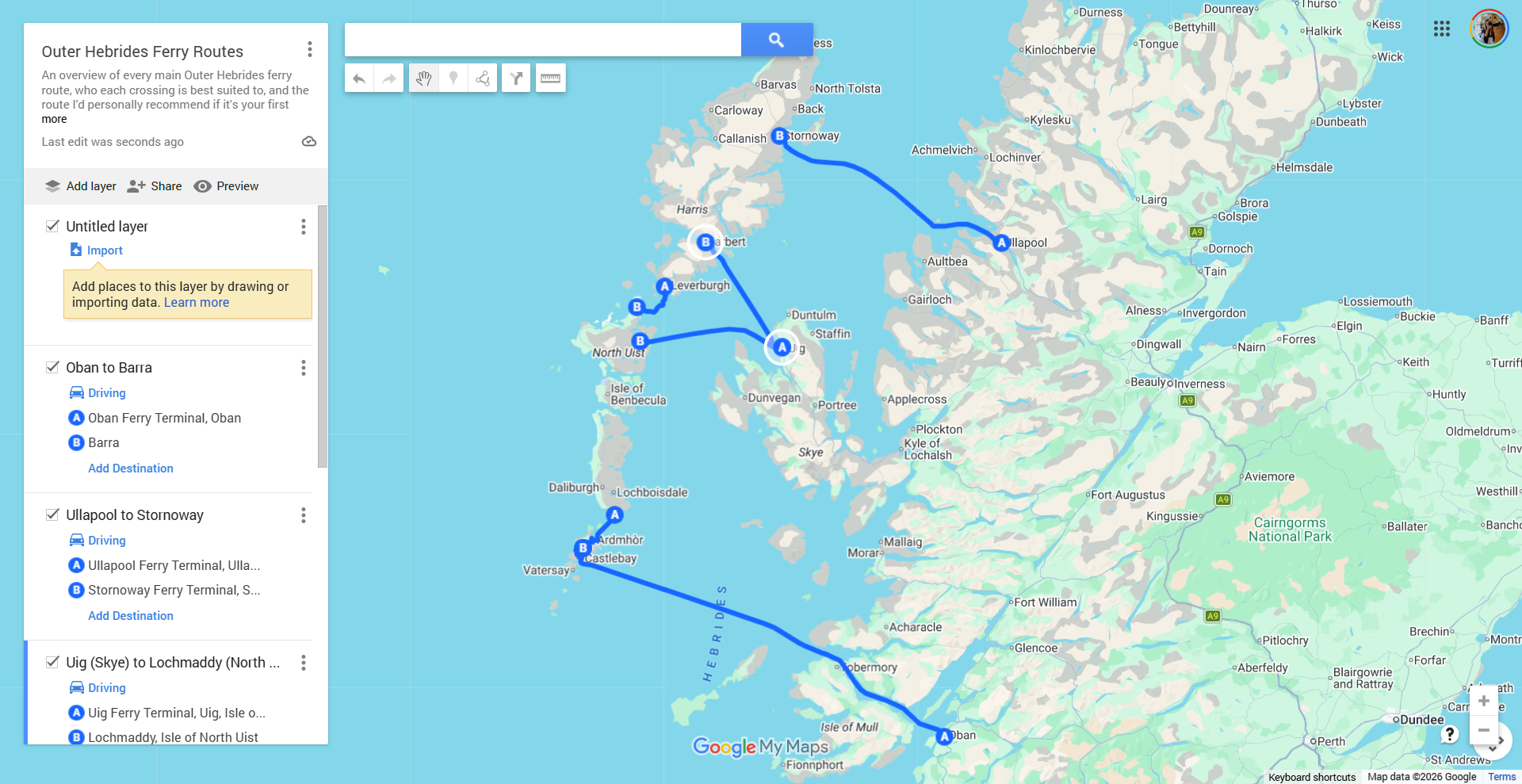
Outer Hebrides Ferry Map
Quick Guide: Which Outer Hebrides Ferry Should You Choose?
If you're just looking for the quick answer, here are the main ferry routes to the Outer Hebrides:
Oban → Castlebay (Barra): approximately 4 hours 45 minutes
Oban → Lochboisdale (South Uist): approximately 5 hours 10 minutes (winter only)
Mallaig → Lochboisdale (South Uist): approximately 3 hours 30 minutes (summer only)
Uig (Isle of Skye) → Lochmaddy (North Uist): approximately 1 hour 45 minutes
Uig (Isle of Skye) → Tarbert (Harris): approximately 1 hour 40 minutes
Ullapool → Stornoway (Lewis): approximately 2 hours 45 minutes
If you're still deciding, here's how I'd narrow it down:
Want to visit Lewis & Harris? Choose Ullapool → Stornoway.
Planning to explore the Uists? Choose Uig → Lochmaddy.
Want to start in Barra? Choose Oban → Castlebay.
Already visiting Skye? One of the Uig crossings usually makes the most sense.
If I had to recommend just one route for a first visit, it would always be Ullapool to Stornoway, before driving south through Lewis, Harris and the Uists, then returning via Lochmaddy to Uig on Skye.
It's a fantastic one-way road trip that lets you experience two different ferry crossings without ever needing to retrace your steps. For me, it strikes the perfect balance between seeing the highlights and keeping the driving enjoyable, which is why it's the route I recommend to clients more than any other.
Who Operates the Outer Hebrides Ferries?
All ferry services between mainland Scotland, Skye and the Outer Hebrides are operated by CalMac.
Most routes operate throughout the year, although some have seasonal schedules or slightly reduced sailings during the winter months. Before booking your accommodation, I always recommend checking the CalMac timetable first, particularly if you're travelling during peak summer season (when sailings are busy) or in the shoulder seasons (when crossings are fewer).
A note on CalMac
CalMac’s summer timetables typically run from late March/early April through to mid-October, while winter timetables usually cover mid-October to March. Booking windows vary each year, so it's worth signing up for their newsletter to be notified when new sailings become available.
It's also worth knowing that ferry travel in the Outer Hebrides is weather-dependent. If your sailing is cancelled, CalMac will usually either transfer your booking to an alternative sailing where possible or arrange a refund, depending on the circumstances.
You can check if sailings are on time or disrupted on the CalMac service status, but you’ll also want to download the app for real-time push notifications, and to keep your tickets in one place. Very handy!
On a personal note, I’ve always found CalMac’s customer service to be excellent and staff incredibly friendly and helpful.
The Outer Hebrides Ferry Routes
Below are the crossings you'll most commonly need when planning an island-hopping adventure, along with my thoughts on who each route works best for.
Ullapool → Stornoway (Lewis) Ferry
Crossing time: Approximately 2 hours 45 minutes
Sailings: Ullapool to Stornoway ferry
If someone asked me where they should start their first Outer Hebrides trip, this would almost always be my answer.
Arriving in Stornoway puts you in the perfect position to explore Lewis before continuing south into Harris. It's also the route that works beautifully as part of a one-way journey through the islands, finishing in the Uists before returning via Skye.
It's one of CalMac's busiest routes, so if you're travelling with a car in spring or summer, I'd book as early as you can. Vehicle spaces often disappear long before foot passenger tickets do.
Best for
First-time visitors
Lewis & Harris
My recommended 4-day and longer itineraries
Uig (Skye) → Tarbert (Harris) Ferry
Crossing time: Approximately 1 hour 40 minutes
Sailings: Uig to Tarbert ferry
If you're already exploring Skye, this is one of my favourite ferry routes.
Rather than driving all the way back to the mainland, you can simply hop across to Harris and continue your journey through the islands. It's one of the shorter crossings too, which is always welcome if you're not particularly fond of being at sea.
This route also works brilliantly if you're planning to drive north through Lewis before returning to the mainland via Ullapool.
Best for
Combining Skye and the Outer Hebrides
Starting your trip in Harris
Shorter ferry crossings
Uig (Skye) → Lochmaddy (North Uist) Ferry
Crossing time: Approximately 1 hour 45 minutes
Sailings: Uig to Lochmaddy ferry
If your focus is the Uists, this is the crossing I'd usually recommend.
Lochmaddy is a fantastic base for exploring North Uist, Benbecula and South Uist, all of which are connected by causeways. This route tends to be a little quieter than the Stornoway crossing and is ideal if you've already decided the Uists are your priority.
Best for
North Uist
The Uists
Skye and Outer Hebrides road trips
Oban → Castlebay (Barra) Ferry
Crossing time: Approximately 4 hours 45 minutes
Sailings: book the Oban to Castlebay ferry
This is the longest of the Outer Hebridean crossings, but arriving into Barra feels like a proper adventure and is a wonderful way to begin exploring the islands.
If you have a week or more, and you'd like to travel the full length of the Outer Hebrides from south to north, this is the perfect place to start.
Best for:
Barra & Vatersay
Longer island road trips
Travelling the full length of the Outer Hebrides
Do You Need Ferries Between the Islands?
One of the biggest surprises for many people is just how connected the Outer Hebrides actually are.
Before my first trip, I assumed I'd be catching ferries every time I wanted to move between islands. In reality, many of the islands (especially those around The Uists) are linked by roads and causeways, making it incredibly easy to drive from one to the next.
The only inter-island ferry crossings you'll normally need are:
Check the CalMac timetables for inter-island sailings and how they link the islands.
Should You Book Your Ferry in Advance?
If there's one piece of advice I'd give anyone planning an Outer Hebrides trip, it's to book your ferries as soon as your dates are confirmed. Popular CalMac sailings regularly sell out months in advance during spring, summer and the school holidays.
Personally, I tend to book my ferries and accommodation together, so I know everything lines up before moving on to the fun part of planning the trip.
Can You Take Your Car on the Ferry?
Yes, all of the main Outer Hebrides ferries carry cars, campervans and motorhomes. When booking with CalMac, you'll enter your vehicle registration and dimensions during the booking process.
However, if you’re renting a car and don’t have this information, add a car and select the “I don’t the details yet” box at the bottom of the page; you’ll need to enter these details once you collect your rental.
Can You Visit the Outer Hebrides Without a Car?
You can visit the Outer Hebrides without a car, and plenty of people do.
If you're travelling around Scotland by public transport, it's perfectly possible to visit as a foot passenger. I'd either recommend hiring a car when you arrive - particularly if you're arriving into Stornoway - or choosing one area to base yourself and using the local bus network.
That said, I do think the Outer Hebrides is one of those destinations that's best experienced with your own car.
Public transport does exist, but services are limited, and many of the islands' best beaches, viewpoints and walking trails are easiest to reach by car.
There’s also the simple freedom of being able to follow your curiosity. Some of my favourite beaches, viewpoints and little detours weren't places I'd planned to visit at all; they were simply spots that caught my eye while driving, and having the flexibility to pull over whenever I wanted is one of the things that made the trip so memorable.
Are the Ferry Crossings Rough?
This is probably one of the questions I'm asked most often, and the honest answer is that it depends entirely on the weather.
The longer crossings across the Minch can occasionally be quite choppy when the Atlantic decides to make itself known. Equally, I've had crossings that were so calm they felt more like sailing across a loch than open sea.
If you're prone to seasickness, it's worth taking medication just in case. But I wouldn't let concerns about rough crossings put you off - most sailings are reasonably quick.
The Hebridean Way
If you're bikepacking or walking the Hebridean Way, which starts at the very southern tip of Vatersay and ends at the Butt of Lewis lighthouse, you’ll need two inter-island ferries alongside two mainland-to-island ferries.
This isn’t a route I’ve walked or cycled (though it’s on my list), but this Hebridean Way post is a great place to start.
